

Fairy vs Faërie
diving head-first into Tolkien's mind and opinions of "fairy-stories"

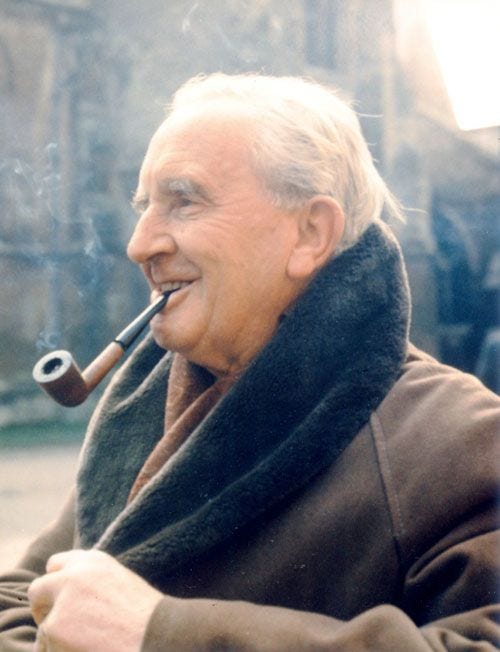
Well, Professor, I’ll hand it to you—you’ve melted my little hobbit brain.
There’s a part of me that felt crazy starting my Tolkien Journey with The Silmarillion… I don’t feel that way any longer, and I am thankful I did not start with On Fairy Stories. I’m not sure I would be typing these words to you right now. The richness and depth of this essay forced me to read these two sections three times before coming here to share about it…
In this episode, I’ll be covering these sections in my 1988 edition of Tree and Leaf:
On Fairy Stories
Fairy-story
Let’s dive in!


“I have been a lover of fairy-stories since I could read”
On Fairy Stories, J. R. R. Tolkien
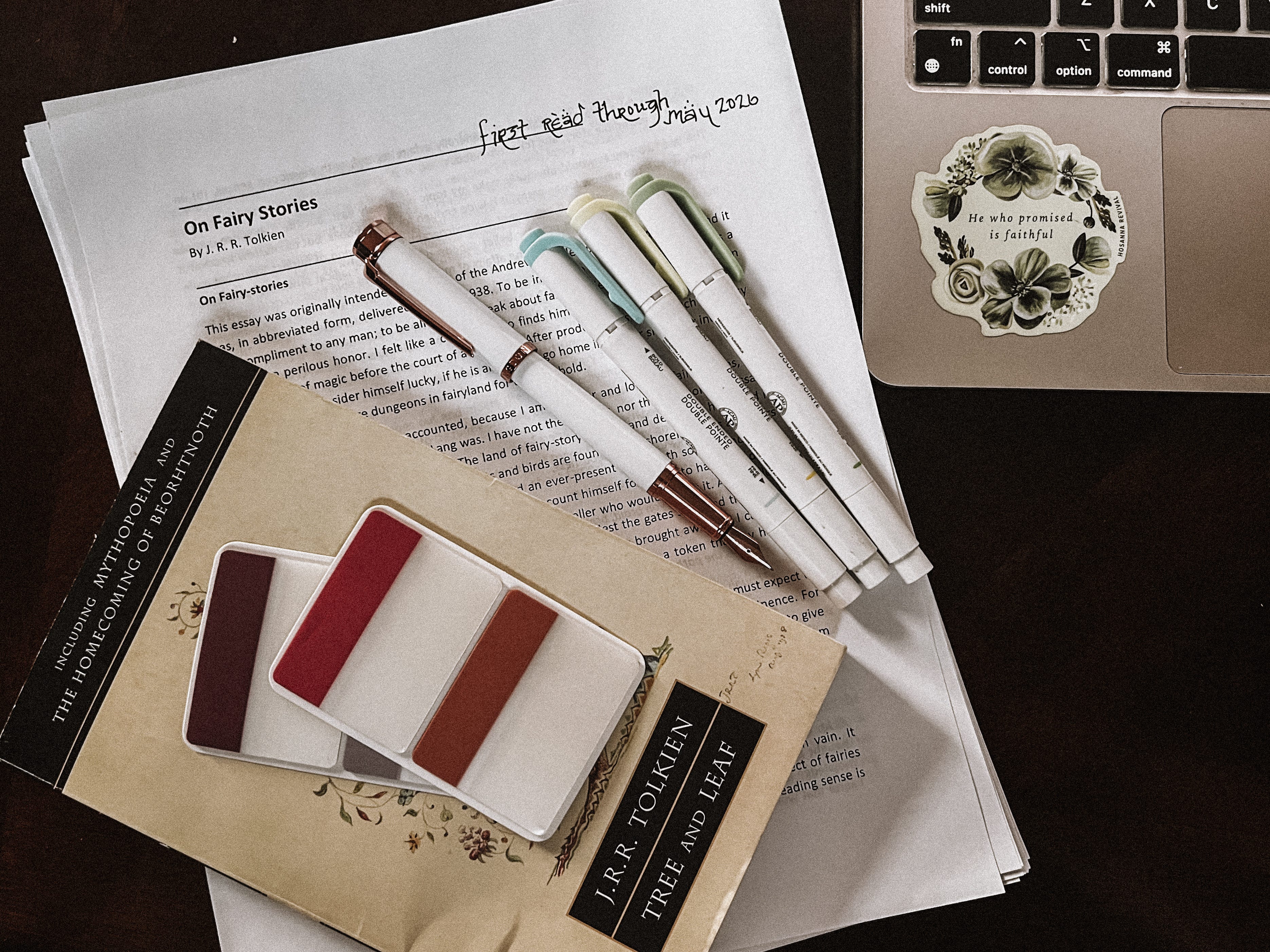
As I opened the pages of this anthology for the first time, the weight of Tolkien’s worlds rested on my shoulders and I stepped into the mind of a legend.
After the first read, I knew I needed help. It was then that I remembered Kelly | themiddlepage did a series earlier this year on Tolkien’s lesser-known works and On Fairy Stories was part of that series. I’m so grateful for the feet that have walked this path before me. I ran to Kelly’s Year of Tolkien Library, printed the online essay and grabbed my pen and highlighters.
I battled, not mainly with Tolkien’s words per se but with the temptation to go and research and purchase every referenced work of other authors to go deeper into the foundations that shaped his own. I’m deliberately forcing myself to remain focused as I tread this path, and I only want to add complimentary books to my shelf in this season… I cannot look at the lights! Even the book in my hands and the online essay were different variations (thankfully only at the beginning) but it took me a minute to re-calibrate!
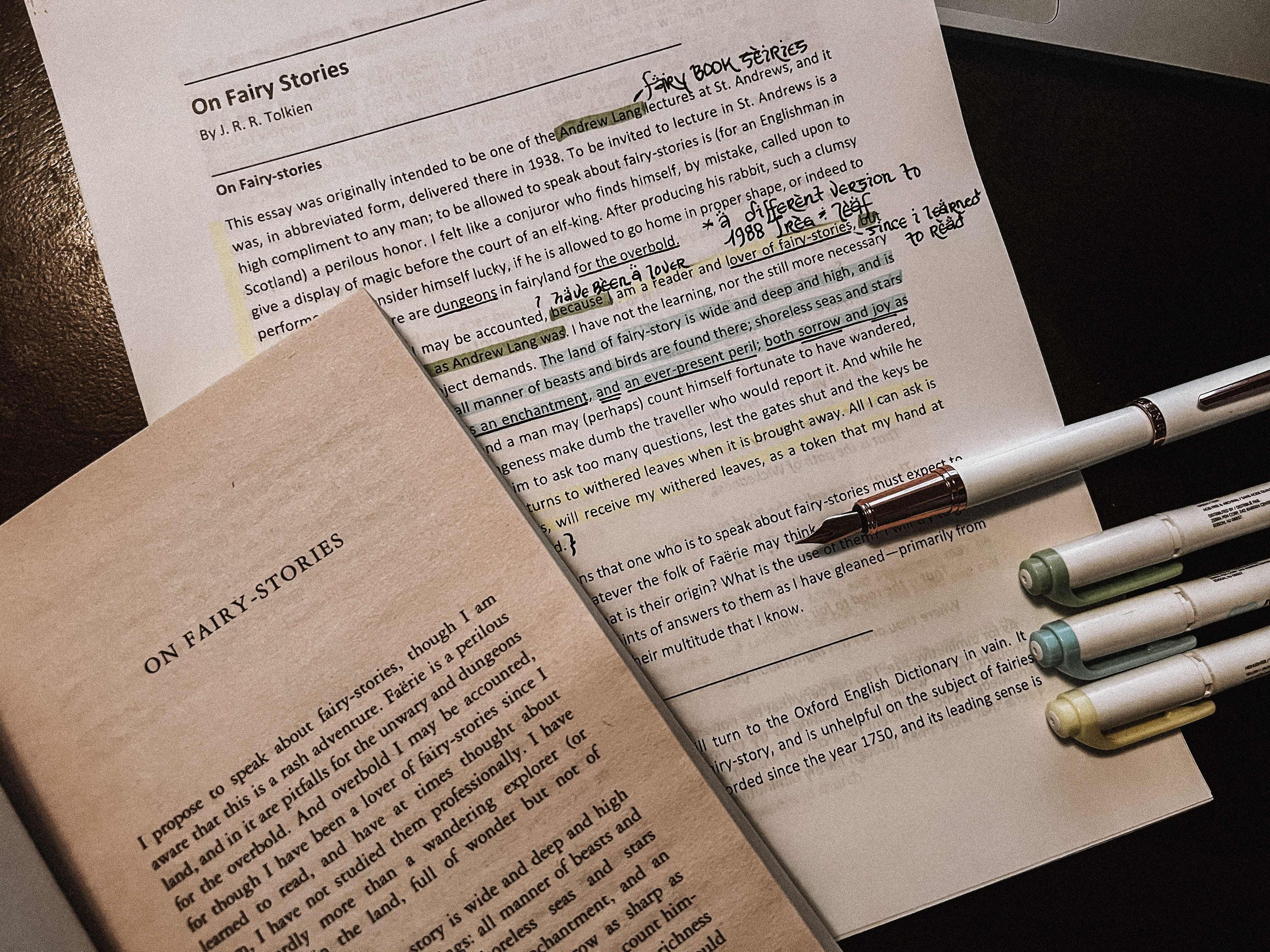
As I shared in my last post, I am following Tea with Tolkien’s reading order and checklist as I make my way through all of these books! If you missed it, you can read it here…

On Fairy Stories was written between the publishing of The Hobbit and the creation of The Lord of the Rings. A lecture turned essay after an invitation to the University of St. Andrews to give a talk on fairy-stories inspired by one of Tolkien’s favorites, Andrew Lang.1 It was this essay that shaped Tolkien’s future writings as he battled with the requests for a sequel to The Hobbit, and this moment became a defining one in his journey.
“The sequel to The Hobbit has remained where it stopped. It has lost my favour and I have no idea what to do with it. For one thing the original Hobbit was never intended to have a sequel...I am really very sorry: for my own sake as well as yours I would like to produce something....I hope inspiration and the mood will return”
The Letters of J. R. R. Tolkien,2 Letter 31
For all our sakes, I am grateful the inspiration and mood did in fact, return!
What Is A Fairy Story?
Tolkien notes four categorizations of “fairy-stories” and gives more depth into why he feels they should be separated and not lumped under one umbrella of “fairy-story”. One of his least favorite, nay “one of the worst ever written” (in Tolkien’s opinion) fairy stories is by one Michael Drayton, and after reading Tolkien’s description of some of the characters, details and storyline in Drayton’s Nymphidia, I admit, I agree with him. As soon as I would have reached the palace walls of spider’s legs, I would have put the book in the donate box! Ha!
Here are Tolkien’s categories of fairy-stories:
Fairy-story - a story about fairies, legends
Traveller’s tales - mortal men encounter the realm of faërie
Dream-story - a sleeping dream, perhaps about faërie or having magical powers in the dream
Beast-fable - a story where animals resemble humans in talk, walk, heroism, etc.
Tolkien shared his disappointment in the descriptive words used for “fairy” and considered it too narrow for an actual “good” story. He expressed his tiredness of the “little girl or little boy goes out and meets a fairy in the flowers” narrative.
As a wordsmith I empathize. Some things must be written outside of the mainstream definitions. Deep calls unto deep. And if we are to have any meaning in this world, we must let our souls “see” into the different realms and let go of the definitions of this realm that so easily ensnare our imaginations.
What is Faërie?
Otherworldly realm; a realm of magic with magical living things
A state of being; enchantment.
“The realm of fairy-story is wide and deep and high and filled with many things: all manner of beasts and birds are found there; shoreless seas and stars uncounted; beauty that is an enchantment, and an ever-present peril; both joy and sorrow as sharp as swords.”
Tree and Leaf (1988), On Fairy Stories, J. R. R. Tolkien
I am grateful for this distinction between “fairy” and “faërie” given by Tolkien, as I believed them to be one in the same for many of my years.
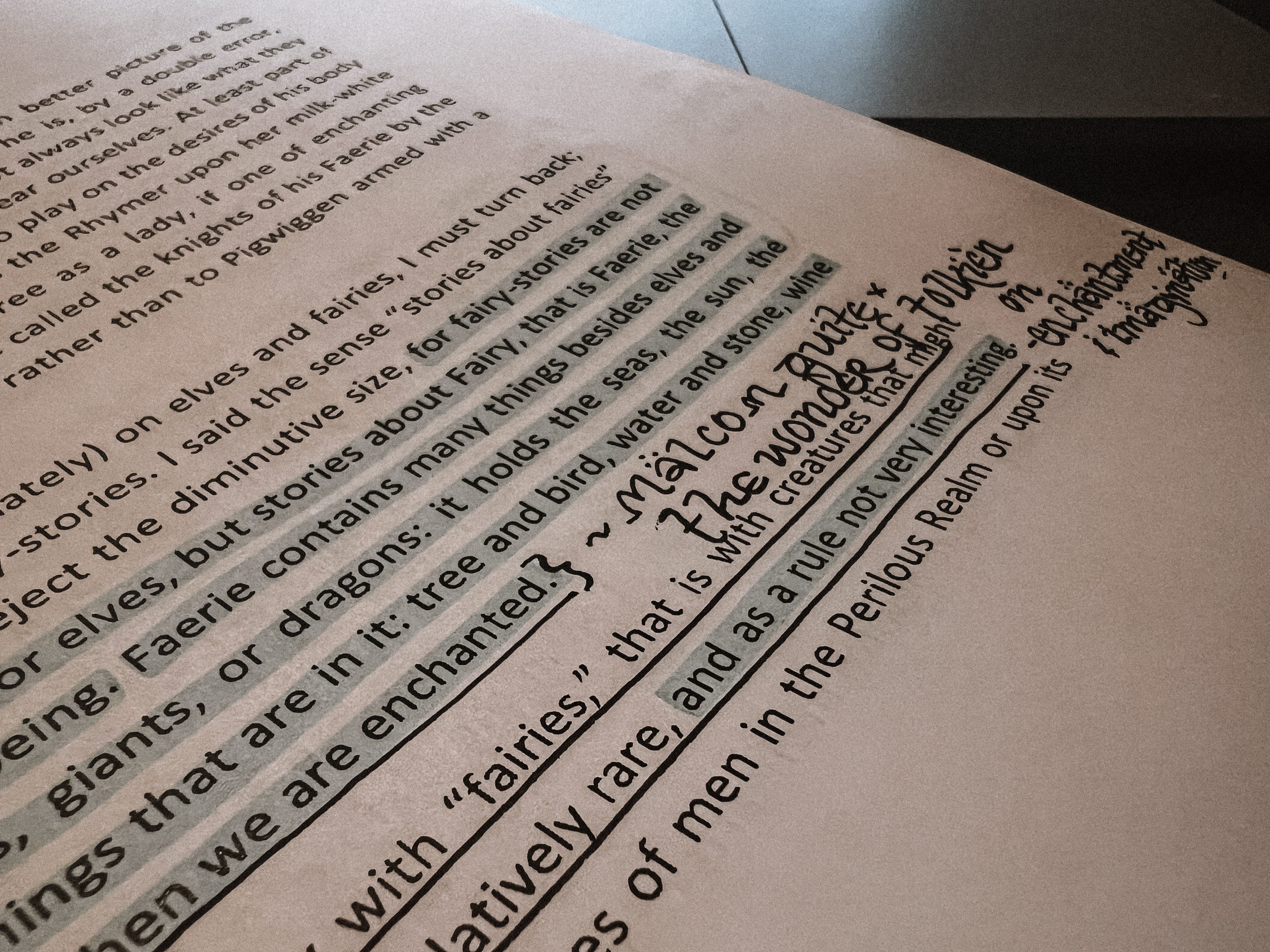
“…for fairy-stories are not in normal English usage stories about fairies or elves, but stories about Fairy, that is Faërie, the realm or state in which fairies have their being. Faërie contains many things besides elves and fays, and besides dwarfs, witches, trolls, giants, or dragons: it holds the seas, the sun, the moon, the sky; and the earth, and all things that are in it: tree and bird, water and stone, wine and bread, and ourselves, mortal men, when we are enchanted.”
On Fairy Stories, Fairy-story, J. R. R. Tolkien
I recently watched an interview with The Wonder of Tolkien and Malcom Guite where Malcom shared exquisite gems on enchantment and imagination. I found this to be perfect timing as I was entering this next series and as always, Christopher and Malcom are a joy to read and listen to.
Fascinating Revelations
As Tolkien began describing Faërie as a realm, I couldn’t help but think of the Creation Story in Genesis.
The sun, the moon, the sky, all of the living things: plants, animals, us. And when Tolkien began describing beast-fable, I sensed in my spirit that the authors who write beast-fables are perhaps being inspired by the Holy Spirit to tap into our origins of Eden, and call us forth to The Day of God—Eternity—where we will commune with the supernatural; we will experience YHWH face to face; we will fellowship with kindred spirits without the chains of time; we will be able to talk… to animals. Selah.
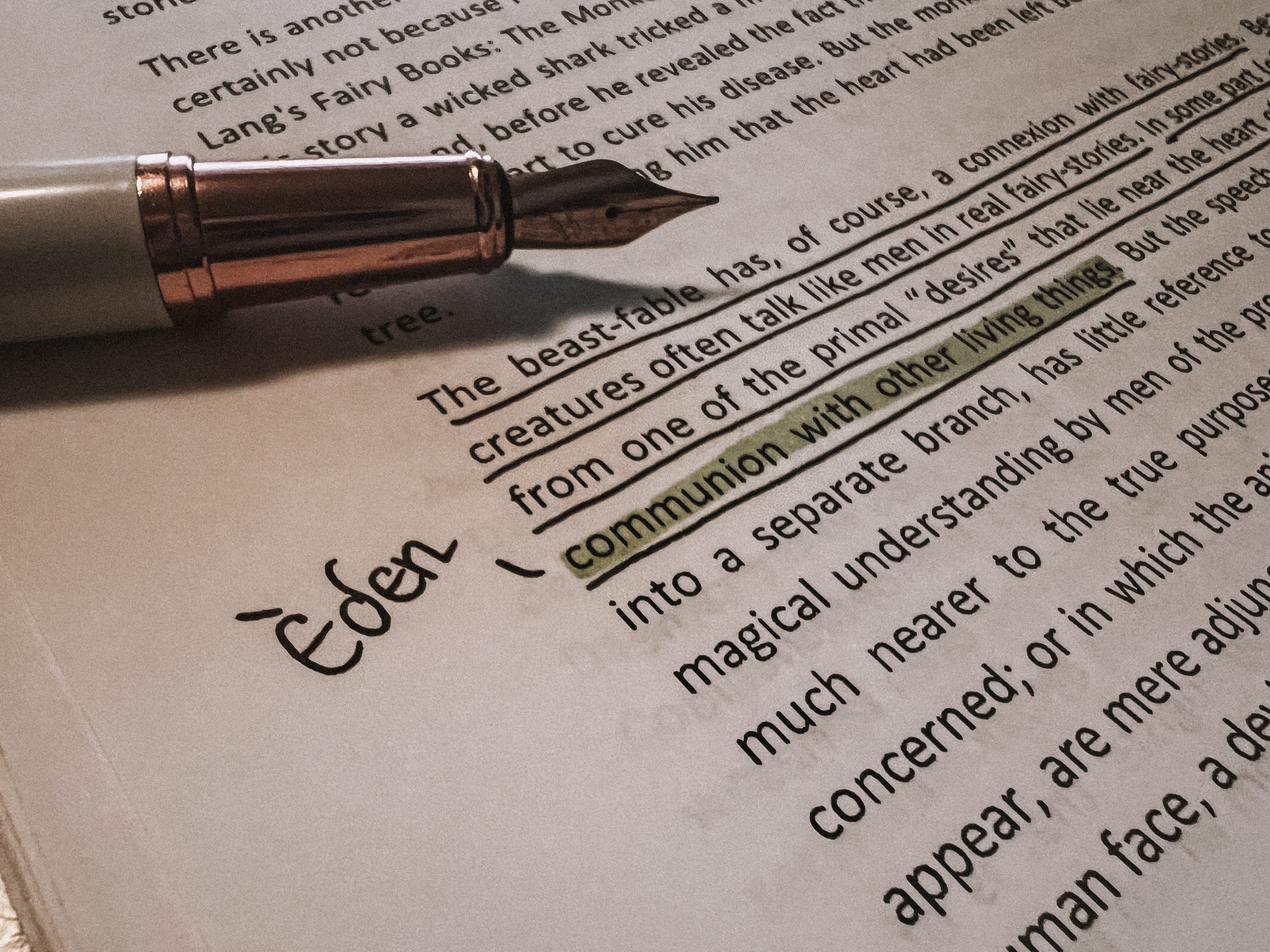
This first episode of On Fairy Stories was deep, but I am thankful for it. I’ve gotten a glimpse into the mind of the Professor as he wandered through the proverbial wilderness of purpose and found the path of fairy-story that gave us The Lord of the Rings and more. I cannot wait to jump into Origins this week!
Take care, my dear friend, and I’ll see you next Sunday!
~Allison

I want to hear your thoughts! Did you know the difference between “fairy” and “faërie” as Tolkien describes them? Does the depth of this essay intrigue you or make you want to run for the rolling hills? Where are you at in your Tolkien journey, and how has his essay On Fairy Stories (or my thoughts on it) impacted you?

About the Author
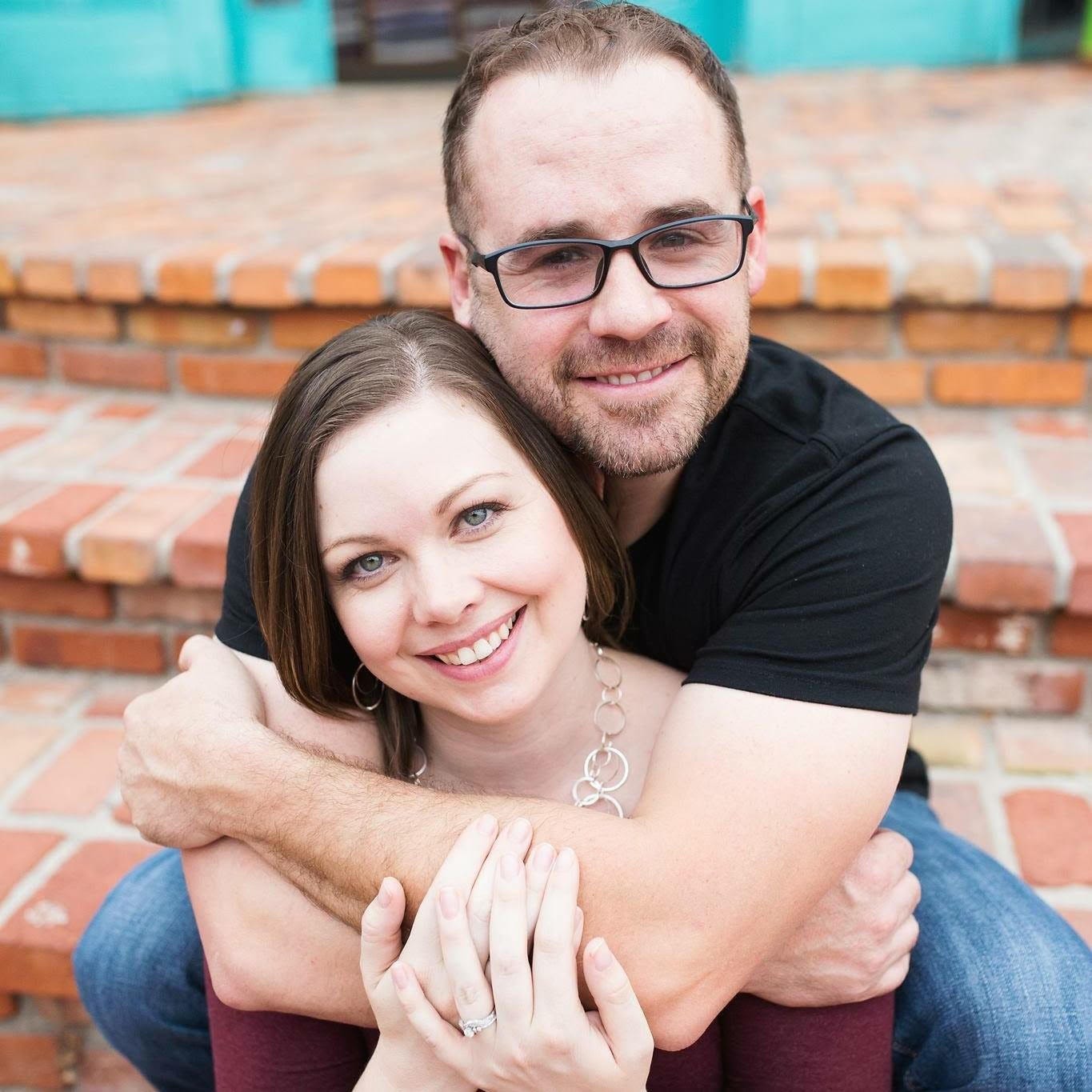
I’m Allison—wife to Hoyt, momma to five and curator of a beautiful life in the heart of The Land of Enchantment, New Mexico, USA.
Tolkien’s works through the eyes of Peter Jackson saved me as a single mother of three…literally. The beauty, the hope, the enchantment of these stories captivated me and there was a reawakening of love and imagination that laid dormant for most of my adult life.
Now, I have just begun my journey of reading all of Tolkien’s works for the first time, and I’m sharing that journey here on Substack. I pray you will join me, and I pray my words bless you, and lead you ever back to the Rock that is higher than I, Jesus Christ.
The fairy/faërie distinction is one of the most important things Tolkien ever wrote, and it's wonderful to see someone encountering it fresh. Tolkien isn't just defending fairy tales as a literary form,he's making a case for the imagination itself as a truth-bearing faculty. Faërie isn't an escape from reality but a way of seeing reality more clearly. He called that ‘recovery,’ and I think it's the single most underappreciated concept in everything he wrote.
Lovely, thank you kindly!! I think this essay is pivotal for fully understanding the legendarium, the perspective undergirding and the richness it can confer 💙